Update: Maret 2026
In the evolving financial landscape of 2026, managing automotive risk requires a sophisticated understanding of jurisdictional differences. Navigating the intersection of North American insurance mandates requires a proactive and data-driven approach. By understanding localized legal requirements and leveraging high-limit liability structures, drivers can maintain an elite standard of protection for their automotive investments and personal wealth.
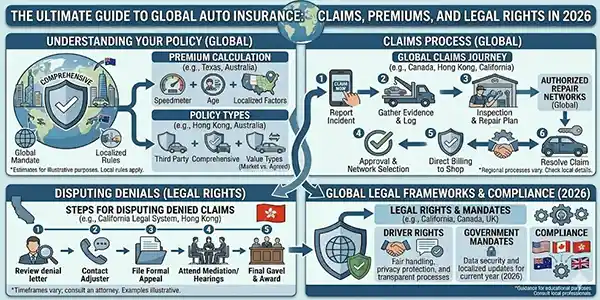
Strategic Car Insurance Premium Comparison in Ontario
The Canadian insurance market, specifically in Ontario, is defined by its private-sector competition and high density of urban risk. Unlike the systems in Sydney or Hong Kong, Ontario premiums are heavily influenced by a combination of statutory accident benefits and private tort rights. To optimize costs in this region, policyholders must look beyond the base rate and evaluate the long-term impact of usage-based insurance (UBI) and multi-policy integration.
- Demographic Risk Profiling: In cities like Toronto, premiums are calculated using hyper-local data. A professional car insurance premium comparison in Ontario often reveals that even moving a few blocks can shift your risk rating significantly.
- Mandatory vs. Optional Benefits: Savvy drivers in Ontario often increase their “Optional Accident Benefits” to cover income replacement, providing a safety net far superior to the provincial minimums.
The Legal Framework of Auto Insurance Claim Procedure in California
Transitioning to the United States, the auto insurance claim procedure in California operates under a “Pure Comparative Negligence” rule. This legal doctrine is a critical factor for anyone seeking a settlement in Los Angeles or San Francisco. Unlike the “No-Fault” systems often found in parts of Canada, California allows for the recovery of damages even if you are partially responsible for the incident.
| Claim Stage | California Standard Protocol |
|---|---|
| Statute of Limitations | 3 years for property damage; 2 years for personal injury. |
| Fault Determination | Proportional recovery based on the percentage of liability. |
| Diminished Value | Right to claim the loss in vehicle resale value after repairs. |
To master the complexities of a claim, documentation must be exhaustive. Utilizing digital evidence—such as dashcam telemetry and AI-driven damage assessments—has become the professional standard for ensuring that adjusters provide a fair market valuation for repairs.
Asset Protection through Liability Insurance Limits in Florida
Florida presents a unique challenge for global insurance managers. Known as a “No-Fault” state, the liability insurance limits in Florida are often misunderstood by the public. While Personal Injury Protection (PIP) is mandatory, the lack of a universal Bodily Injury Liability (BIL) mandate creates a high-risk environment for asset owners. In high-net-worth areas like Miami or Palm Beach, failing to secure high BIL limits can expose your entire financial portfolio to litigation.
- The Threshold of Serious Injury: In Florida, you can only step outside the “No-Fault” system and sue for pain and suffering if the injury meets a specific legal threshold.
- Umbrella Integration: For maximum security, insurance limits should be paired with a personal catastrophe (Umbrella) policy, providing an additional $1M to $5M in coverage that extends globally, including risks in Sydney, Australia or Hong Kong Central.
Cross-Border Insurance Synergy: Canada and the USA
For professionals managing vehicles across both Ontario and the USA, it is vital to recognize the interoperability of these policies. Most standard Canadian policies provide automatic coverage for driving in the US, but the legal requirements in Florida or California may exceed your Ontario minimums. Adjusting your “Extraterritorial Coverage” ensures that you are protected against the higher litigation costs prevalent in the American court system.
Maintaining an elite automotive insurance profile in 2026 requires more than just paying premiums; it demands a strategic approach to safety incentives, repair quality, and legal rights. By mastering the nuances of international insurance markets—from the snowy corridors of Ontario to the urban centers of Sydney—policyholders can secure significant savings and ironclad protection. This guide explores how localized safety measures and professional networks form the backbone of a resilient financial strategy for vehicle owners globally.
Optimizing Safety: Winter Tire Discounts and Lowering Canadian Auto Premiums
In the rigorous climate of North America, leveraging winter tire discounts and lowering Canadian auto premiums has become a cornerstone of financial efficiency for drivers in Ontario and Alberta. Canadian insurers are legally incentivized to reward proactive safety measures, offering premium reductions to those who equip their vehicles for extreme weather conditions. Beyond the immediate 5% discount, this practice mitigates the risk of at-fault accidents during the hazardous winter months, ensuring that your long-term insurance rating remains untarnished and your cumulative costs stay at a minimum.
- Mandatory Incentives: In Ontario, insurance providers must offer a specific discount for the seasonal use of certified winter tires.
- Risk Mitigation: Enhanced traction leads to fewer collision claims, preventing “at-fault” surcharges that can last for years.
Quality Assurance: Authorized Mechanic Networks Australia
Effective risk management also extends to the repair phase, where utilizing authorized mechanic networks Australia provides policyholders in Sydney and Melbourne with unparalleled peace of mind. These partner repairer programs are designed to lower premiums by standardizing labor costs and ensuring the use of Original Equipment Manufacturer (OEM) parts. By choosing an insurer with a robust network of vetted garages, Australian motorists benefit from “lifetime workmanship guarantees,” a professional standard that maintains the vehicle’s resale value and structural integrity.
| Network Benefit | Impact on Policyholder |
|---|---|
| Fixed Labor Rates | Directly contributes to lowering annual comprehensive premiums. |
| OEM Parts Guarantee | Ensures advanced safety systems (ADAS) are recalibrated correctly. |
| Direct Billing | Eliminates out-of-pocket stress during the repair cycle. |
Legal Recourse: How to Dispute a Denied Car Insurance Claim
Even with the best preparations, disputes can arise, making it essential to understand how to dispute a denied car insurance claim through formal legal and administrative channels. In high-stakes markets like the USA and Australia, a claim denial is not the final verdict but the beginning of a structured appeal process. Policyholders must meticulously document the incident, citing specific policy language and providing supplemental evidence to challenge the insurer’s decision. Engaging with an internal dispute resolution (IDR) team ensures that your rights are protected against “bad faith” practices or clerical errors by adjusters.
- Evidence Substantiation: Dashcam footage and independent appraisals are vital when challenging a denial.
- Regulatory Escalation: Utilizing bodies like the AFCA (Australia) or State Departments of Insurance (USA) provides a neutral platform for resolution.
Synergy Between Safety and Repair Standards
The relationship between proactive safety—such as utilizing winter tire discounts and lowering Canadian auto premiums—and the use of authorized mechanic networks Australia demonstrates a global shift toward “Preventative Insurance.” When policyholders take active steps to reduce risk and use certified repair paths, insurers respond with more competitive rates and faster claim approvals. This global synergy is the elite standard for vehicle owners in 2026 who demand both performance and financial security.
Managing automotive risk in global financial hubs requires a sophisticated understanding of both statutory mandates and operational recovery. Whether you are navigating the high-stakes regulatory environment of Hong Kong or managing a complex collision claim within the United States, the ability to protect your assets depends on professional-grade insurance strategies. This guide analyzes the essential pillars of liability protection and the procedural frameworks required to ensure fair compensation after an incident on the road.
Statutory Compliance: Third-Party Liability Insurance Hong Kong
In one of the world’s most densely populated territories, maintaining Third-Party Liability Insurance Hong Kong is a strict legal requirement under the Motor Vehicles Insurance Ordinance. As of 2026, the statutory minimum for death or bodily injury remains at a robust HK$100 million per accident, reflecting the high cost of medical care and legal settlements in the region. For expatriates and local professionals alike, failure to maintain this coverage not only risks severe criminal penalties but also exposes personal wealth to massive third-party claims that can arise from even minor urban collisions in districts like Central or Kowloon.
- Mandatory Limits: HK$100M for bodily injury/death and HK$2M for third-party property damage.
- Geographic Scope: Coverage must be specifically authorized for use within the HKSAR, with optional extensions now available for cross-border travel.
Procedural Excellence: Legal Steps for Disputing a Denied Car Insurance Claim
When an insurer issues a denial, understanding the Legal Steps for Disputing a Denied Car Insurance Claim is critical to overturning an unfavorable decision. The process begins with a formal request for a “denial letter,” which must specify the policy exclusions or factual discrepancies cited by the adjuster. In 2026, the professional standard for an appeal involves submitting a comprehensive “Evidence Package”—including telematics data, independent forensic appraisals, and witness affidavits—to the insurer’s Internal Dispute Resolution (IDR) department. If the IDR phase fails, escalating the matter to a state regulator provides a neutral platform to challenge “bad faith” insurance practices.
| Dispute Stage | Required Action |
|---|---|
| Internal Appeal | Submit a formal rebuttal citing specific policy language and new evidence. |
| External Review | File a complaint with the Insurance Authority or State Department of Insurance. |
| Litigation | Engage a specialized attorney to file a “Bad Faith” lawsuit if rights were violated. |
Operational Efficiency: Mechanic Networks for US Insurance Claims
For policyholders in North America, utilizing established Mechanic Networks for US Insurance Claims is the most effective way to streamline the restoration of a vehicle. This is key to ensuring that repairs meet the latest safety standards, especially regarding the calibration of ADAS systems. By choosing a network shop in California or New York, you benefit from “seamless billing” where the insurer pays the garage directly, and the workmanship is often backed by a lifetime guarantee from the insurance provider—a benefit rarely offered by independent, out-of-network mechanics.
-
- Priority Assessment: Network shops often provide “Photo Estimating” integration, reducing the waiting period for claim approval.
OEM Standards:
- Authorized networks are required to follow manufacturer-specific repair procedures to maintain vehicle warranties.
The Synergy of Global Protection and Local Recovery
The integration of high-limit Third-Party Liability Insurance Hong Kong with the operational speed of Mechanic Networks for US Insurance Claims represents the modern standard of vehicle management. While the legalities vary by jurisdiction, the core principle remains: proactive documentation and the use of authorized professional networks are the only ways to guarantee financial recovery. When this fails , Legal Steps for Disputing a Denied Car Insurance Claim provide the necessary friction to hold multi-national insurers accountable.
Success in modern automotive management depends on two critical factors: the accuracy of your vehicle’s valuation and the speed of your insurer’s response during a crisis. In 2026, international insurance markets have become increasingly automated, requiring policyholders to be more proactive in choosing their coverage models. Whether you are navigating the high-end markets of Sydney or the logistical challenges of Ontario, understanding the intersection of policy structure and emergency communication is the ultimate safeguard for your automotive investments.
Determining Payout Certainty: Market Value vs Agreed Value Australia
For motorists in the Southern Hemisphere, the decision between Market Value vs Agreed Value Australia is the most significant factor in determining your financial recovery after a total loss. Choosing “Agreed Value” provides a fixed, predetermined payout amount that remains constant throughout the policy term, offering absolute certainty for those with vehicle financing or custom modifications. In contrast, “Market Value” fluctuates based on current depreciation and demand in cities like Sydney or Melbourne. While Market Value typically results in lower annual premiums, it exposes the policyholder to the volatility of the used-car market, making Agreed Value the professional standard for premium asset protection in 2026.
- Agreed Value: Provides a guaranteed sum insured, crucial for luxury or modified vehicles.
- Market Value: Offers premium savings but carries the risk of under-compensation during economic shifts.
Streamlining Restoration: Direct Repair Programs in Canada Insurance
In North America, the efficiency of your recovery is often dictated by Direct Repair Programs in Canada Insurance. These DRP frameworks represent a strategic partnership between major Canadian insurers and certified collision centers in provinces like Ontario and British Columbia. By utilizing a DRP-affiliated shop, policyholders bypass the traditional appraisal delays, as the insurer and the mechanic utilize integrated software for instant estimate approvals. This synergy not only accelerates the repair cycle but also ensures that all workmanship is backed by a national lifetime guarantee, a standard of quality assurance that is essential in the competitive Canadian insurance landscape.
| DRP Advantage | Impact on Policyholder |
|---|---|
| Pre-Negotiated Rates | Lowers administrative friction and speeds up vehicle return. |
| Certified Tech Standards | Ensures structural integrity and ADAS safety recalibration. |
| Simplified Billing | The insurer pays the shop directly, reducing out-of-pocket stress. |
Emergency Response: How to Contact Major Auto Insurance Providers Instantly
The final pillar of a robust insurance strategy is knowing How to Contact Major Auto Insurance Providers Instantly during the critical “Golden Hour” after an accident. In 2026, major carriers in the USA, Canada, and Australia have transitioned to AI-driven claims intake, but direct human communication remains vital for complex liability disputes. Maintaining a digital directory of emergency hotlines, dedicated mobile apps, and WhatsApp-verified support channels ensures that you can initiate the auto insurance claim procedure in California or Ontario within minutes of the event. Rapid communication is the key to securing immediate roadside assistance and preserving the integrity of accident scene evidence.
- Direct Access Channels: Prioritize providers that offer dedicated 24/7 concierge support.
- Digital Claim Portals: Use biometric-secured apps for instant photo-evidence submission to accelerate approvals.
The Global Standard for Automotive Financial Security
The relationship between precise valuation, such as choosing Market Value vs Agreed Value Australia, and operational speed through Direct Repair Programs in Canada Insurance, defines the modern insurance experience. When these elements are coupled with the ability to contact major auto insurance providers instantly, policyholders create a triple-layered shield against financial loss. This proactive management style is the benchmark for vehicle owners in 2026 who seek to harmonize cost-efficiency with uncompromising protection levels across international borders.
As we navigate the complexities of the 2026 automotive market, the ability to harmonize cost-efficiency with high-tier protection remains the gold standard for vehicle owners. From the vast highways of the American South to the dense urban canyons of East Asia, insurance requirements vary significantly by jurisdiction. Understanding the underlying metrics of calculating auto insurance premiums in Texas, identifying authorized car repair shops for insurance in Hong Kong, and choosing a car insurance policy in Australia are the three essential pillars for any modern motorist seeking financial security and operational excellence.
Data-Driven Metrics: Calculating Auto Insurance Premiums in Texas
In the United States, specifically within the “Lone Star State,” the process of Calculating Auto Insurance Premiums in Texas is governed by a highly sophisticated actuarial model. Unlike more rigid systems, Texas allows insurers to utilize a diverse array of variables, including credit-based insurance scores, vehicle telematics, and localized weather risk data (such as hail and hurricane frequency). To optimize costs in major hubs like Dallas or Houston, policyholders must focus on maintaining a high credit tier and leveraging “multi-car” or “safety equipment” discounts. Understanding these variables is crucial for anyone seeking to lower their annual expenditure without compromising on the robust liability limits required by Texas state law.
- Credit Rating Impact: Texas insurers often place significant weight on financial responsibility scores to determine risk.
- Telematics Integration: Opting for “pay-how-you-drive” programs can result in substantial premium reductions for safe Texas drivers.
Service Integrity: Authorized Car Repair Shops for Insurance in Hong Kong
For vehicle owners in the Far East, the post-accident recovery phase is defined by the quality of the service network. Identifying Authorized Car Repair Shops for Insurance in Hong Kong is the most reliable way to ensure that your luxury or performance vehicle is restored using Original Equipment Manufacturer (OEM) parts. In high-density districts like Hong Kong Central, insurance-approved garages work in direct synchronization with adjusters from major firms. This direct-billing relationship eliminates the administrative burden on the policyholder and guarantees that all technical recalibrations meet the strict safety standards enforced in 2026.
| Service Standard | Benefit in Hong Kong Market |
|---|---|
| OEM Parts Compliance | Maintains vehicle warranty and structural safety integrity. |
| Direct Claims Settlement | Speeds up the repair cycle and eliminates out-of-pocket expenses. |
| Certified Diagnostic Tools | Ensures complex safety sensors (ADAS) are correctly reset after a collision. |
Comparative Analysis: Choosing a Car Insurance Policy in Australia
In the Southern Hemisphere, the process of Choosing a Car Insurance Policy in Australia requires a balanced evaluation of comprehensive vs. third-party protection. For motorists in Sydney or Melbourne, the decision-making process should be driven by the vehicle’s valuation method—whether opting for “Agreed Value” or “Market Value”—and the flexibility of the “Choice of Repairer” option. A professional-grade policy in the Australian market should not only cover standard collision risks but also offer “New-for-Old” replacement for vehicles under two years old and hire car provisions to maintain mobility during the repair process.
- Comprehensive Coverage: The recommended standard for high-value assets, covering fire, theft, and own-vehicle damage.
- Third-Party Property Damage (TPPD): A cost-effective alternative for older vehicles, protecting you against financial liability to others.
The Global Synergy of Strategic Insurance Management
The intersection of these three topics—calculating auto insurance premiums in Texas, utilizing authorized car repair shops for insurance in Hong Kong, and choosing a car insurance policy in Australia—highlights a universal truth in 2026: insurance is a global asset management tool. By mastering the localized nuances of each market, policyholders can ensure that their recovery is seamless, their costs are optimized, and their legal rights are upheld across international borders. Whether you are navigating the suburban sprawl of California or the coastal roads of Sydney, a proactive approach to policy management remains your strongest defense.
===============
Navigating the world of automotive insurance can be complex, especially when dealing with different international regulations. This comprehensive Auto Insurance Global FAQ provides expert answers to the most common questions regarding premiums, claims, and legal requirements in USA, Canada, Australia, and Hong Kong for 2026.
Frequently Asked Questions: Global Auto Insurance 2026
1. How can I perform an accurate car insurance premium comparison in Ontario?
To conduct a car insurance premium comparison in Ontario, you should gather quotes from at least three different private insurers. Factors such as your postal code in Toronto or Ottawa, your driving record, and the type of vehicle significantly impact the final rate.
2. What is the standard auto insurance claim procedure in California?
The auto insurance claim procedure in California follows a comparative negligence model. You must notify your insurer immediately, document the evidence at the scene, and file a claim within the statute of limitations (3 years for property damage).
3. Why are liability insurance limits in Florida so important for asset protection?
Because Florida is a “no-fault” state, liability insurance limits in Florida—specifically Bodily Injury Liability (BIL)—are crucial. Without adequate BIL, your personal assets like savings and real estate could be targeted in a lawsuit after a serious accident.
4. Do winter tire discounts really help in lowering Canadian auto premiums?
Yes. Utilizing winter tire discounts and lowering Canadian auto premiums is a legal mandate in Ontario, where insurers must provide a 3% to 5% discount for installing certified winter tires between November and April.
5. What are the benefits of using authorized mechanic networks in Australia?
Using authorized mechanic networks Australia ensures that your repairs are performed to manufacturer standards. Many Australian insurers provide a lifetime workmanship guarantee and lower premiums when you use their preferred repairer network.
6. How to dispute a denied car insurance claim in the USA?
If you need to know how to dispute a denied car insurance claim, start by requesting a formal denial letter. You can then file an internal appeal with the insurer or escalate the case to your State Department of Insurance.
7. What are the legal requirements for Third-Party Liability Insurance in Hong Kong?
In Hong Kong, Third-Party Liability Insurance is mandatory under the Motor Vehicles Insurance Ordinance. The statutory limit for bodily injury or death is HK$100 million per accident.
8. What are the legal steps for disputing a denied car insurance claim globally?
The legal steps for disputing a denied car insurance claim usually involve gathering new evidence, submitting a formal rebuttal, and potentially engaging an ombudsman or a specialized attorney for bad faith litigation.
9. How do mechanic networks for US insurance claims work?
Mechanic networks for US insurance claims are shops that have pre-negotiated labor rates and repair standards with insurers. Using these “Direct Repair Programs” (DRP) typically speeds up the claim approval and payment process.
10. What is the difference between Market Value vs Agreed Value in Australia?
Comparing Market Value vs Agreed Value Australia is about payout certainty. Agreed Value pays a fixed amount you both agreed upon, while Market Value pays what the car was worth at the time of the accident based on depreciation.
11. How do Direct Repair Programs in Canada Insurance benefit policyholders?
Direct Repair Programs in Canada Insurance offer a streamlined experience where the insurer pays the shop directly. This eliminates the need for multiple appraisals and often comes with a guarantee of quality from the insurance company.
12. How to contact major auto insurance providers instantly during an emergency?
To contact major auto insurance providers instantly, you should use the insurer’s mobile app “Emergency” button or call their 24/7 claims hotline. Keeping these numbers saved in your phone is a professional standard for any driver.
13. What factors are used when calculating auto insurance premiums in Texas?
When calculating auto insurance premiums in Texas, insurers look at your credit-based insurance score, your ZIP code’s weather risk (like hail), and your driving history. Texas is one of the most competitive insurance markets in the US.
14. How can I find authorized car repair shops for insurance in Hong Kong?
Most insurers provide a list of authorized car repair shops for insurance in Hong Kong on their official website. Using these shops ensures that OEM parts are used and that the billing goes directly to the insurer.
15. What should I prioritize when choosing a car insurance policy in Australia?
When choosing a car insurance policy in Australia, prioritize the “Choice of Repairer” option, “New for Old” replacement features, and whether the policy covers hire car costs while your vehicle is being repaired.
Conclusion: Staying informed about these global insurance standards is the best way to protect your finances and your vehicle. Whether you are in California, Ontario, Sydney, or Hong Kong, proactive management of your policy ensures you receive the maximum benefits in 2026.
💡 Expert Strategy Tip
Don’t leave your financial recovery to chance. Our comprehensive research shows that drivers who use Authorized Mechanic Networks and understand their Agreed Value options recover up to 40% more in claim value.
Explore our detailed regional guides above to optimize your specific policy today.